A daunting passage appears on the third page of the Clementi Sonatina Op. 36, No. 3 in Suzuki Book 3.
Here is Evan, working through the RH chords. He is doing three at a time, and then putting them together. Here, he is working through measures 42 and 43. This method will continue until measure 45 when it is merely a descending scale.
For those of you participating in the Preparatory B level of the Achievement Program assessment this December, here is an example of how to practice your broken triads:
Practice this in C Major and G Major in addition to your Pentascales in A, E, F, e minor and d minor as well as your full scales in C and G.
As you may well know, chords provide the basis of harmonic support for a melody and much of the "background" (or often in beginning music - the left hand). This harmonic support is comprised of a progression of chords in one form or another. Many of you will already be comfortable with the alberti bass pattern of playing chords. (5-1-3-1)
Below is a chord progression in C in blocked form. (That means, all the notes of the chord are played at once.) The chord progression is I-IV-I-V-V7-I, which in the key of C is C-F-C-G-G7-C.
The chord progression should be practiced slowly, with even tone and a flexible wrist.
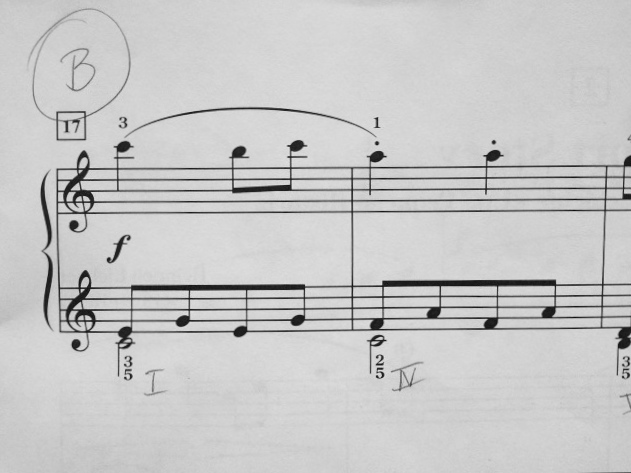
If your child has been practicing his chord progression, scale, and arpeggio in the key of C, starting Suzuki Book 2 is going to be so easy! Unblocking the LH in the B section of Ecossaise though can be intimidating to a child who has never before had to decipher the following notation:
But walking through the first two measures carefully in lesson will make it easy for your child to proceed confidently with the rest of it on his own!
The girls in this video were trying to express on their faces how the sounds for Major and Minor made them feel. What kinds of feelings do you have when you hear Major? What kinds of feelings do you have when you hear Minor?
Listen to what other students play, what your teacher plays, and what you hear in school, at work, or on the radio - can you tell the difference between major and minor?