Search This Blog

Showing posts with label Suzuki 2. Show all posts

Monday, September 15, 2014

Counting at the end of Hungarian Folk Song - Suzuki Book 2

If you have mastered the down-ups - the slurred chords, the accents and the coordination needed to play this piece, congratulations!  There's just one more thing - the counting in the last line of the piece!

Here is the last line - it looks easy!  But make sure you count.  (The beats are written in for you here.)


And here is a student practicing it:


Friday, April 25, 2014

Beethoven Sonatina LH, Suzuki Book 2

At this point in music study, the melody of a new piece is very easy for a student to pick up.  I always get them started with the LH so that they feel comfortable moving on with the piece.  After the slide up into the black keys in m. 1-2 of this Sonatina, it is measures 3-4 that pose the bigger difficulty.


The top line of the LH chords is going to be legato, while the bottom line needs to lift in order to repeat the same note.  Here is how it is done:


Wednesday, September 25, 2013

Melody, Suzuki Book 2

Melody, while simple in sound, has its moments of complication!

Measures 7-8 and measures 11-12 have finger switches and movement that takes practice!

The finger switch in measure 8 is the one that students forgo quickly, which causes a tense stretch between fingers 3 and 4.  The last three beats of measure 8 should be practiced on their own first.

Measures 7-8:


The finger switch in measure 11 insures that the melodic line will remain legato.  It feels symmetrical in the hands since the LH is also inching down the keyboard by placing the thumb on treble G.

Measures 11-12:


And there you have it!

Friday, November 16, 2012

Short Story Ending

Sometimes the rests make all the difference.  The coordination of rests and quarter notes against eighth notes at the end of Short Story sometimes give students difficulty.  I'd like to share with you a beautiful example of how it should be done.  This student is exaggerating his rests to feel the movement throughout the continued rhythm in the other hand.  It makes things much easier!


The rests you see the student playing are below, circled in pink, and the green arrows indicate the notes that are not to be played staccato.  


Minuet in G minor, RH B section

One of the things your child cannot learn from just listening to the CD is how to use proper and efficient fingering.  For this, you'll have to open the book!  In Minuet in G minor, there are some fingering options that you might see in your book and I propose the following, based on what my students have used to get the best results.


We are, of course looking at the B section, measures 9 - 16.  The A section is quite easily learned by ear.


Friday, November 9, 2012

Minuet 1 LH B section

Very similar to the first line of the A section, the B section LH of Minuet 1 poses some difficult at times  in coordination.  The octave figure in measure 18 is very similar to the one in the A section, but teachers the student how to do the same thing in a different key.  Measure 20 is essentially the reversal of measure 18.


Here is how it would look to play this line:

Tuesday, September 11, 2012

Short Story - B section HT

Sometimes this passage of LH scales and RH chords comes naturally to a student, and sometimes one has trouble figuring out how exactly they fit together.  And then there is the tricky business of making the beautiful sweeping B section line up with measure 15, which you have worked so hard on already!


Just take a breath, listen to the CD and let your hands try it out.  If that doesn't work, here is a quick clip that might help you out if you can't remember how it worked in your lesson this past week!


Wednesday, June 27, 2012

Ecossaise, LHA - Suzuki 1

Congratulations!  You've started Suzuki Book 2!  This is an exciting moment.  Luckily, we get to celebrate with a pretty exciting piece.  The thing that makes this piece sound so exciting is the staccato in the left hand.  Articulation (rests, staccatos, accents, slurs....) is very important in Book 2 and you'll find it to be very important in this piece as well.  Watch how this student plays the "jumps" and the "legatos" in the A section:

The C Chord Progression

As you may well know, chords provide the basis of harmonic support for a melody and much of the "background" (or often in beginning music - the left hand).  This harmonic support is comprised of a progression of chords in one form or another.  Many of you will already be comfortable with the alberti bass pattern of playing chords.  (5-1-3-1)

Below is a chord progression in C in blocked form.  (That means, all the notes of the chord are played at once.)  The chord progression is I-IV-I-V-V7-I, which in the key of C is C-F-C-G-G7-C.


The chord progression should be practiced slowly, with even tone and a flexible wrist.

The C Arpeggio

In order to play much of Suzuki Book 2 and any early intermediate literature, a student needs to be able to play an arpeggio with ease.  An arpeggio outlines a triad and provides both melody and harmony in a quick, easy, and charming way to a lot of piano music.

Small hands need to be careful though, not to have an excess of stretching.  The arm should support the hand, which should support the fingers, which should all be carried along to each note.

Below is an example of a child learning the C arpeggio.  The notes are C-E-G-C with fingering for the right hand being 1-2-3-5 (coming back down with the same notes and respective fingerings).

Monday, February 20, 2012

Ecossaise Grace Note Passage, Suzuki Book 2

If your child has a difficult time practicing slowly, the following passage sometimes gets away from them and isn't played properly.  The articulation is more complicated here, as you can see:


Here is a student demonstrating how the passage should be practiced slowly with good articulation:


Short Story RH B section Thirds, Suzuki Book 2

Accompanying a melody by thirds and sixths in one hand is a pianists technique that is often introduced in simple right hand scale passages.  In the Suzuki piano repertoire, this is introduced in the B section of Short Story.


It is important that the student be able to play even thirds while bringing out the top note melody.  Here is a video of a student learning this passage for the first time in her lesson.  She came to lesson already being able to play the top notes of the passage by ear.  By using "touch - play" and incorporating her wrist into the movement, she is able to play the thirds evenly and staccato, when necessary.


Friday, February 10, 2012

Ecossaise LH B section, Suzuki Book 2

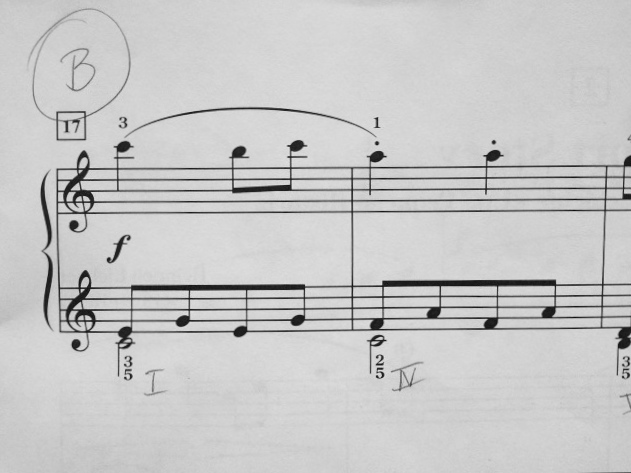
If your child has been practicing his chord progression, scale, and arpeggio in the key of C, starting Suzuki Book 2 is going to be so easy!  Unblocking the LH in the B section of Ecossaise though can be intimidating to a child who has never before had to decipher the following notation:


But walking through the first two measures carefully in lesson will make it easy for your child to proceed confidently with the rest of it on his own!


Monday, November 7, 2011

Happy Farmer, Left Hand, A1 Section, Suzuki Book 2

The Left Hand of Happy Farmer is usually very easy to learn.  A combination of arpeggios and by-ear trial-and-error gets the bulk of it done in minutes.  Measure fourteen though, is typically pretty daunting for students who become intimidated with that harmonic sixth that includes a Bflat.


From the C and the A in measure 13 though, the student's hand is already in the shape of a sixth.  Have them identify the two harmonic intervals in measure 14 followed by the single landmark note before showing them how it is done.


What a fun piece to play!

Saturday, October 22, 2011

Short Story, Left Hand - Suzuki Book 2

Short Story is easy for the left hand, isn't it?  It is just chords we've mostly played before and scales, right?  Yup!  Until measure 15.  I know you can read these notes.... the first one is above or below middle C??

But, just to make things a little easier, here is a video that shows measures 14 - 16 played with the correct fingering.  (Fingering is getting more and more important as your pieces get more and more interesting!)


When you start to look at the right hand in this spot, it is important to notice what notes stay the same and what notes are different.
.

Minuet 1, Left Hand - Suzuki Book 2

Confused by the strange notation in the second measure of the left hand in Minuet 1?  It's no biggie!  Your thumb will hold that dotted half note for the entire three beats while you play the rest of the measure!
Like this!


The rest is easy.  Don't forget the f sharps!

Thursday, October 13, 2011

Ecossaise RH A section, Suzuki Book 2


Here is the right hand of the first page of Ecossaise in Suzuki Book 2 played with correct fingering and articulation with a small hand.