the goal should be playing the opening phrase like so:
Tuesday, February 28, 2012
French Children's Song - HT - Suzuki Book 1
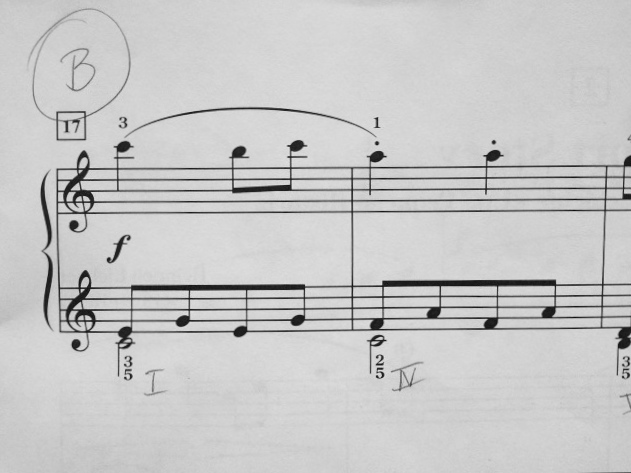
One of the tricky things about putting hands together in French Children's Song is that it begins with a repeated note in the right hand. After doing some careful legato practice, and simplifying it into smaller steps:
the goal should be playing the opening phrase like so:
the goal should be playing the opening phrase like so:

Careful Legato Practice
When one hand needs to change chords, or repeat a note, while the other hand is expected to play a legato line, sometimes a student finds this difficult to practice. Sometimes "willing" it to happen will work, but it isn't very efficient.
Instead, incorporating an exaggerated movement into the hand that lifts will help disconnect the reliance the hands have on eachother to do the same thing. Like this!
Pauline's left hand has a singing melody, while her right hand needs to change chords. Before practicing this way, both hands would lift and the musical effect would be jarring.
Instead, incorporating an exaggerated movement into the hand that lifts will help disconnect the reliance the hands have on eachother to do the same thing. Like this!
Pauline's left hand has a singing melody, while her right hand needs to change chords. Before practicing this way, both hands would lift and the musical effect would be jarring.
Monday, February 20, 2012
Ecossaise Grace Note Passage, Suzuki Book 2
If your child has a difficult time practicing slowly, the following passage sometimes gets away from them and isn't played properly. The articulation is more complicated here, as you can see:

Here is a student demonstrating how the passage should be practiced slowly with good articulation:
Here is a student demonstrating how the passage should be practiced slowly with good articulation:
Short Story RH B section Thirds, Suzuki Book 2
Accompanying a melody by thirds and sixths in one hand is a pianists technique that is often introduced in simple right hand scale passages. In the Suzuki piano repertoire, this is introduced in the B section of Short Story.

It is important that the student be able to play even thirds while bringing out the top note melody. Here is a video of a student learning this passage for the first time in her lesson. She came to lesson already being able to play the top notes of the passage by ear. By using "touch - play" and incorporating her wrist into the movement, she is able to play the thirds evenly and staccato, when necessary.
It is important that the student be able to play even thirds while bringing out the top note melody. Here is a video of a student learning this passage for the first time in her lesson. She came to lesson already being able to play the top notes of the passage by ear. By using "touch - play" and incorporating her wrist into the movement, she is able to play the thirds evenly and staccato, when necessary.
Friday, February 10, 2012
Ecossaise LH B section, Suzuki Book 2
If your child has been practicing his chord progression, scale, and arpeggio in the key of C, starting Suzuki Book 2 is going to be so easy! Unblocking the LH in the B section of Ecossaise though can be intimidating to a child who has never before had to decipher the following notation:

But walking through the first two measures carefully in lesson will make it easy for your child to proceed confidently with the rest of it on his own!
Thursday, January 19, 2012
Chant Arabe B section LH
By now, you understand that there is a lot to this little piece! We've worked on balance, we've worked on having a flexible wrist, we've worked on phrasing. There is this one little bit though at the end of the B section that often gives kids an issue.

To learn this little bit, and to coordinate it later with the RH, I find it is easiest to choreograph the octave leap. My students practice it as follows:
To learn this little bit, and to coordinate it later with the RH, I find it is easiest to choreograph the octave leap. My students practice it as follows:
Wednesday, January 18, 2012
Body Staff Basics
If you are a parent new to piano lessons, you might be bewildered by the concept of the "body staff." A staff is the set of lines and spaces used to place notes on to make reading music easy and organized. At the very basic level, students need to get used to the ideas of highs and lows, steps and skips. This can be facilitated in an easy and fun way using the body staff. Pictured below is a diagram of how the body can be used corresponding to notes on the scale (please don't be disturbed that the child in the diagram looks like a gingerbread man).
 Some of the most basic songs can be practiced on the body staff. Here are two examples that you may be working on in your lessons!
Hot Crossed Buns
and Honeybee
Subscribe to:
Comments (Atom)